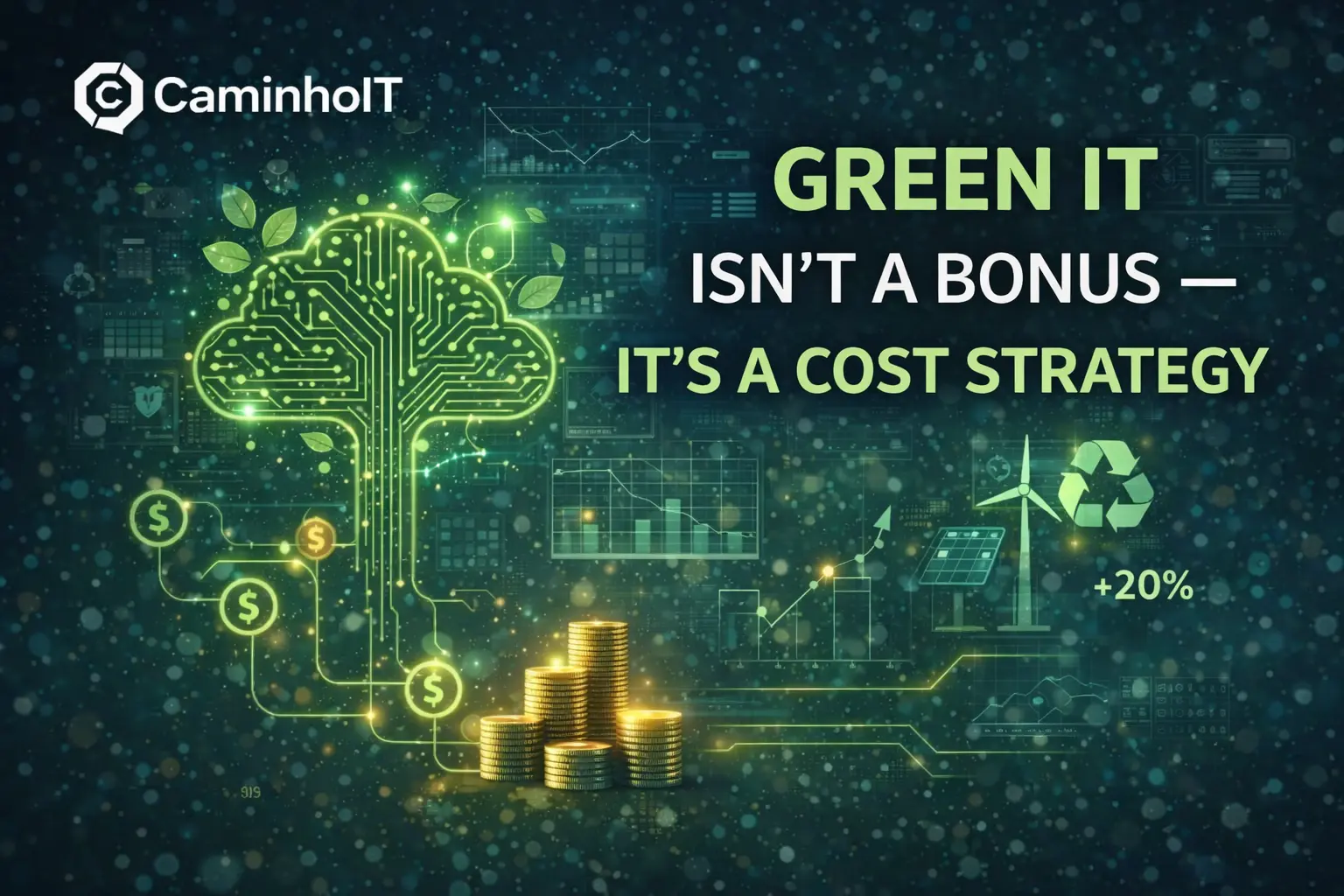
Green IT Isn't a Bonus — It's a Cost Strategy
Here's what most businesses get wrong about green IT.
They think it's about virtue. Offsetting carbon. Marketing the right values. Checking a box for regulators.
It's not.
Green IT is about not wasting money on things you don't need.
The Carbon Cost Is Just the Financial Cost Made Visible
Think about it:
Idle cloud resources cost you money AND energy. Over-provisioned infrastructure costs you money AND power. Inefficient systems cost you money AND emissions.
These aren't separate problems.
They're the same problem, looked at from two angles.
When you stop paying for cloud drift, you also stop burning electricity on things you're not using. When you right-size your infrastructure, you reduce both cost and carbon simultaneously.
Green IT isn't a separate initiative. It's what intentional infrastructure looks like.
Why This Matters in 2026 (And Beyond)
UK 2030 and Portugal 2030 aren't optional policy goals anymore.
They're connected to:
- Funding eligibility
- Supplier requirements
- Partnership agreements
- Regulatory compliance
- Investor confidence
- Partner expectations
Companies that treat sustainability as a compliance checkbox will struggle. Companies that treat it as a cost optimization strategy will thrive.
Because the math is identical.
Use less. Spend less. Emit less.
It's the same decision, three ways of measuring it.
The Business Case Is Obvious (When You Frame It Right)
Here's how this typically gets pitched wrong:
"We should go green because it's the right thing to do."
That's nice. Nobody budgets for "the right thing."
Here's how it should be pitched:
"We can reduce cloud costs 20-30% while simultaneously meeting our 2030 targets and improving efficiency."
Now you have people listening.
Because you're not asking them to sacrifice. You're showing them the same action solves multiple problems.
What Green IT Actually Means
It's not about replacing everything with renewable energy. It's not about buying carbon offsets. It's not even primarily about new technology.
It's about:
Using less Shut down what you're not using. Right-size what you are. Eliminate redundancy.
This is Post #4 work. This is also green IT work.
Measuring what you use You can't optimize what you don't measure. So track: energy consumption per workload, infrastructure efficiency ratios, resource utilization.
This is Post #2 work (ownership). This is also green IT work.
Making intentional choices Every system, every tool, every resource should exist because someone decided it should. Not because it was spun up and forgotten. Not because it's "how we've always done it."
This is Post #3 work (governance). This is also green IT work.
Building for efficiency, not excess Stop designing for "peak day of the year." Design for typical load, with elasticity for peaks.
This is Post #4 work (right-sizing). This is also green IT work.
Why This Breaks Down in Most Companies
Here's the friction point:
Finance cares about cost. Operations cares about uptime. Sustainability cares about emissions. Leadership cares about compliance and brand.
All of these people want the same outcome (efficient infrastructure). But they're not having the same conversation.
So green IT becomes a side project. A marketing initiative. Something separate from "real IT."
When actually, it's the same work.
How to Actually Make This Work
Stop treating green IT as a separate program.
Make it part of your regular IT governance.
In your monthly review (from Post #2-3), add one line:
Energy efficiency
What's your infrastructure consuming? Is it trending up or down? Why? What's the trend toward your 2030 target?
That's it.
One conversation. One metric. Same monthly rhythm.
Suddenly:
- Finance can show cost reduction
- Operations can show efficiency gains
- Sustainability can show emissions reduction
- Leadership can show 2030 progress
All from the same data.
The Companies Already Doing This Are Winning
They have cloud bills that are predictable and declining. They can answer sustainability questions without guessing. They qualify for funding programs tied to efficiency. They meet supplier requirements without extra programs. They can tell a coherent story about infrastructure to investors, partners, and regulators.
The companies that aren't doing this? They have flat or rising costs. They can't answer basic questions about their footprint. They're scrambling when audits happen. They're seen as reactive, not intentional.
This Is Where Your Infrastructure Narrative Changes
Posts 1-4 built the foundation:
- "Good enough IT fails" — urgency
- "Unowned IT bleeds" — why clarity matters
- "Here's what ownership looks like" — how to get there
- "Why cloud costs drift" — concrete money problem
Post 5 ties it together:
Intentional infrastructure is cost-efficient, operationally sound, and aligned with your 2030 goals.
You're not doing this for sustainability. You're doing sustainability as a side effect of doing IT properly.
The Question For Your Business
Are you:
- Paying for infrastructure you don't fully understand? (Post 1-2)
- Running systems without clear governance? (Post 3)
- Experiencing unexplained cost drift? (Post 4)
- Treating green IT as separate from business IT? (This post)
If yes to any of these, 2026 is when that costs you.
If no, you're already ahead.
The businesses that own their infrastructure intentionally—measuring cost, efficiency, and sustainability as one conversation—are the ones scaling confidently into 2030.
Everyone else is explaining their cloud bill to the CFO and hoping regulators don't ask too many questions.
The Baseline Truth
Green IT isn't about being virtuous. It's about being competent.
It's not a bonus initiative. It's what happens when you actually govern your infrastructure with intent.
Measure it. Own it. Optimize it. Repeat.
The cost goes down. The efficiency goes up. The sustainability metrics improve.
And that's not a coincidence.
That's what happens when you stop treating IT as something that "just works" and start treating it as something that's supposed to work.